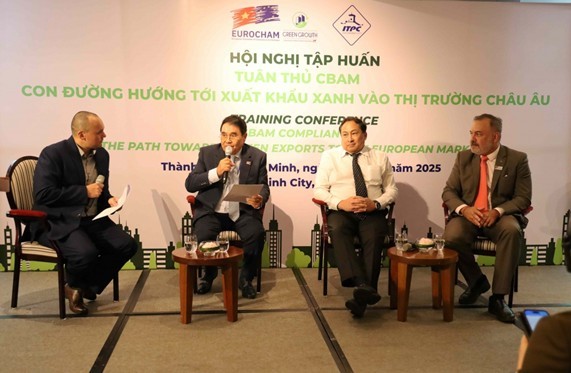
To sustain and expand their market share in the European Union, Vietnamese businesses must align with new regulations, including the Carbon Border Adjustment Mechanism (CBAM). This policy not only mandates transparency in carbon emissions throughout the production cycle but also promotes the adoption of clean technologies and environmentally responsible manufacturing practices.

Ms. Ho Thi Quyen – Deputy Director of ITPC
On May 7, 2025, the Ho Chi Minh City Trade and Investment Promotion Center (ITPC), in collaboration with the Green Growth Subcommittee of the European Chamber of Commerce in Vietnam (EuroCham GGSC), hosted a training conference titled “CBAM Compliance: The Path Towards Green Exports to the European Market.” The event aimed to support Vietnamese enterprises in building green export capabilities, ensuring regulatory compliance, enhancing competitiveness, and accessing major international markets, particularly Europe.
In her opening remarks, Ms. Ho Thi Quyen, Deputy Director of ITPC, stated: “As the world strives for a transition to a green economy and sustainable development, the European Union has rolled out the CBAM to curb greenhouse gas emissions and foster cleaner production. While this presents significant challenges, it also offers an opportunity for Vietnamese businesses to enhance competitiveness and meet international standards.”

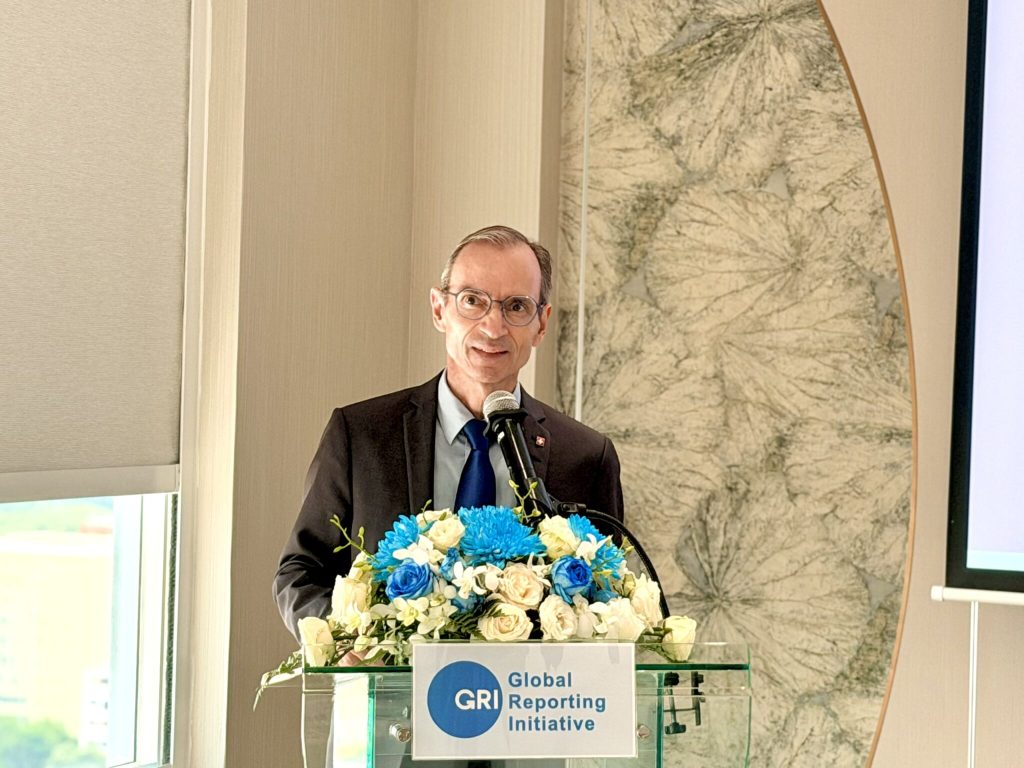
Mr. Jacques Bouflet – Vice President in charge of EuroCham Policy
According to the General Statistics Office, Vietnam’s total import-export turnover in Q1/2025 reached USD 202.52 billion, marking a 13.7% year-on-year increase. Exports rose by 10.6%, and imports by 17.0%. Notably, exports to the EU hit USD 13.7 billion, up 12.7% compared to the same period in 2024—underscoring the EU’s continuing role as a key and promising market for Vietnamese goods.
Under Decision No. 232/QD-TTg dated January 24, 2025, Vietnam will pilot an Emissions Trading System (ETS), laying the groundwork for domestic carbon pricing. Concurrently, the Prime Minister has instructed relevant ministries and agencies to develop a carbon market aligned with Vietnamese law, national development goals, and international commitments on emission reduction.
Also addressing the conference, Ms. Do Thi Hong Duyen, Vice Chair of EuroCham GGSC, emphasized: “CBAM is a cornerstone of the EU’s Green Deal. From January 2026, importers into the EU must declare the carbon footprint of goods such as steel, aluminum, cement, and fertilizers. CBAM compliance can open doors for Vietnamese companies to diversify exports and establish a stronger presence in Europe—a market that places environmental responsibility at its core. While the transition is complex, particularly for carbon-intensive industries, it’s also a strategic opportunity. Forward-thinking businesses will not only mitigate risks but also gain competitive advantage in the global green economy.”

Mr. Jonathan Sourintha – Vice President of EuroCham GGSC
CBAM compliance requires not only regulatory enforcement but also proactive commitment from businesses. Companies are encouraged to invest in clean technologies, optimize production processes, develop comprehensive emissions management systems, and build capacity in emissions reporting and verification. A shift to green production impacts not only individual enterprises but the broader supply chain. When suppliers reduce emissions, the entire value chain moves closer to achieving the net-zero emissions target by 2050.

Mr. William L. Nolten, Board Member of Rexil Asia
At the event, Mr. William L. Nolten, Board Member of Rexil Asia, outlined key differences between existing emission reporting frameworks and new mechanisms such as CBAM: “CBAM is a mandatory, product-level tool (PCF), applying to specific imported items. It differs from the GHG Protocol, which is voluntary and enterprise-level (CCF). Together with regulations like the EU Deforestation Regulation (EUDR) and similar laws in the US and UK, CBAM is increasing pressure on international companies to manage and disclose their emissions transparently.”

The conference was organized with the aim of supporting Vietnamese businesses in the process of improving their green export capacity to comply with regulations and strengthen their competitiveness and expand into major markets, especially Europe.
Dr. Nguyen Phuong Nam, CEO of Klinova Climate Innovation Consulting, presented a detailed technical roadmap for CBAM compliance, noting: “CBAM presents a number of challenges—from stringent reporting requirements and complex data collection to heightened competition, as EU importers will prioritize low-emission products. Vietnamese exporters need to understand CBAM in depth, reassess their production processes, and build comprehensive greenhouse gas emission databases. Conducting product-level emission inventories and planning effective mitigation strategies—such as adopting renewable energy or optimizing technology—will be essential.”
Within the same session, Mr. Ta Van Thuan, Head of International Business at Ca Mau Petroleum Fertilizer JSC (PVCFC), shared insights into his company’s emission-reduction strategy: “PVCFC, a member of PetroVietnam, aims to cut CO₂ emissions by 80,000 tons per year by 2030, and 220,000 tons annually by 2050. Measures include CO₂ recovery, trials of low-emission hydrogen production, and greater reliance on renewable sources like solar and biomass. We also plan to launch at least two new low-emission fertilizer products before 2050, using eco-friendly materials such as urea enriched with NBPT and DCD to stabilize nitrogen, along with NPK and organic fertilizers infused with Bacillus spp. microorganisms.”
Ms. Nina Miron Claudia, Policy Officer at the European Commission’s Directorate-General for Taxation and Customs Union (TAXUD), reaffirmed CBAM’s importance: “CBAM is a key instrument of the European Commission to drive decarbonization. It complies with international law and WTO rules, and it accounts for carbon prices already paid by third-country operators.”
To simplify implementation, the European Commission has proposed a de minimis threshold—exempting importers bringing in less than 50 tonnes per year of iron and steel, aluminum, cement, or fertilizers. This aims to ease administrative burdens for small importers while maintaining environmental effectiveness. The mechanism also supports decarbonization efforts in third countries by applying an “actual emissions” methodology and allowing for deductions based on the carbon price already paid.
Source: Tudonghoangaynay.vn
- Northann Corp Enters Strategic Relationship with Rexil Group of Companies Netherlands to Promote Sustainable Technology and Products
- HUSCO SIGNS STRATEGIC COOPERATION WITH GOLDEN GATE BCE GROUP (THE NETHERLANDS) TO ADVANCE SUSTAINABLE AGRICULTURE
- Golden Gate BCE and Green Transition Sign MOU to Strengthen ESG & Green Transition Support in Vietnam
- GRI 2026 Announcement Event: A Green Passport for Vietnamese Businesses
- LPF FUND connects international green capital flows for sustainable development projects.
- ESG data: Vietnam’s ‘digital passport’ to participate in the global game.